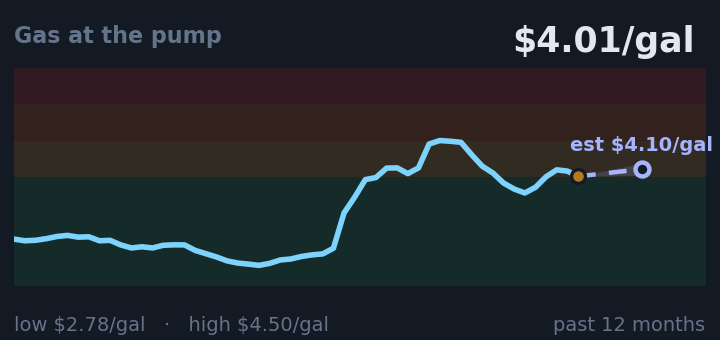
Gas prices at $4.01 a gallon historically correlate with household spending cutbacks and political approval declines; this elevation weighs on consumer confidence and discretionary decisions.
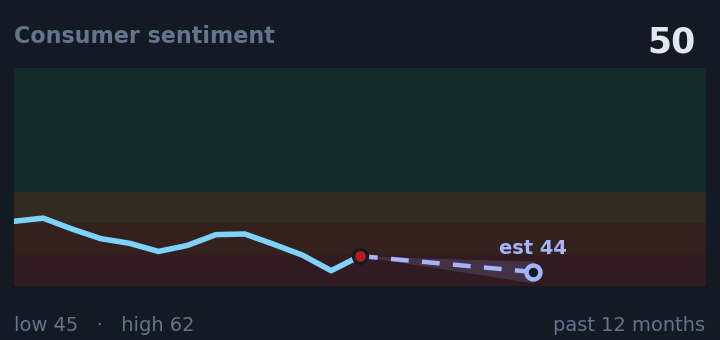
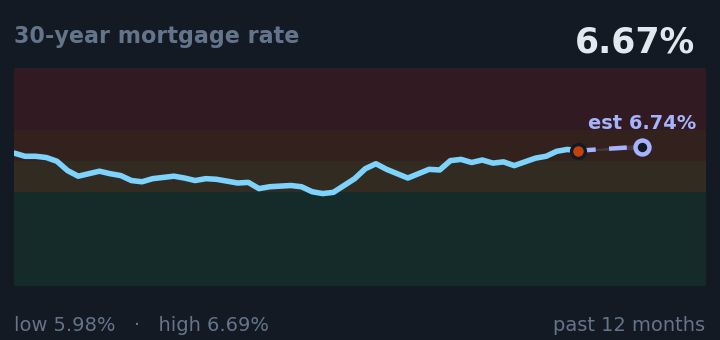
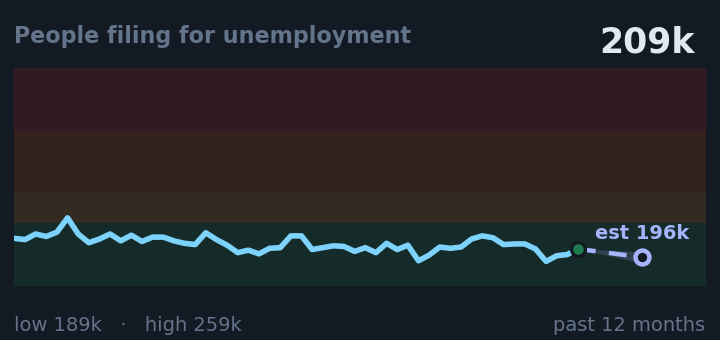
On August 13, this brief named the second-place finisher race in the Florida Republican governor primary at a 24% chance; traders have since moved that market to 74%, a shift of 50 percentage points in four days. The North Carolina Senate race swung hard the opposite direction: called at 33% on August 13, it has fallen to 2% since, a swing of 31 points as traders shifted sharply on the Democratic margin of victory. Three of the five biggest movers sit clustered in the Americas: the second-place race in Florida, odds on Goldman Sachs underwriting Anthropic's IPO in Oregon, and odds on Robert F. Kennedy Jr. exiting the Cabinet. The RFK Jr market has fallen 20 points over the past month to now read 87% NO, one of the clearest sustained moves on the board. The household wallet bears the same month-long squeeze: gas at $4.01 per gallon (up from $3.78), thirty-year mortgages at 6.67% (up from 6.49%), and consumer sentiment at 50 (up from 45 but still signaling spending caution). Jobless claims at 209,000 provide one stabilizing force as households navigate higher borrowing costs and fuel prices.
→ Open the live interactive board
Get this every morning
Delivered to your inbox at 6:30, with the full archive, alerts, and the live board →
Gas prices at $4.01 a gallon historically correlate with household spending cutbacks and political approval declines; this elevation weighs on consumer confidence and discretionary decisions.
Consumer sentiment at 50 indicates severe household pessimism; spending contraction typically follows when households express this level of caution about their financial condition.
Thirty-year mortgage rates at 6.67% suppress housing demand as higher borrowing costs price out buyers and slow the accumulation of household wealth through homeownership.
Source: FRED
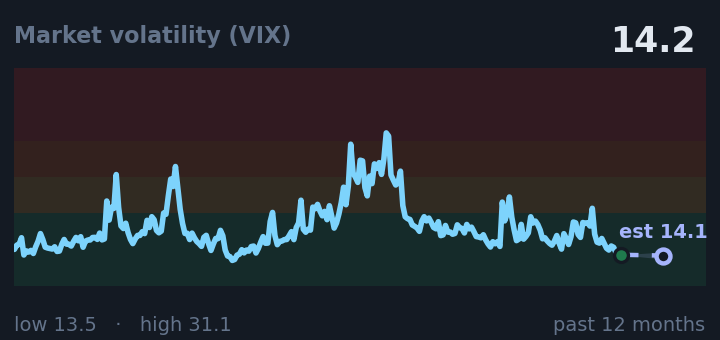
Volatility at 14.6 is near its yearly low, signaling traders see minimal near-term risk and allowing political and corporate bets to move on their own fundamentals rather than broader market fear.
Source: FRED
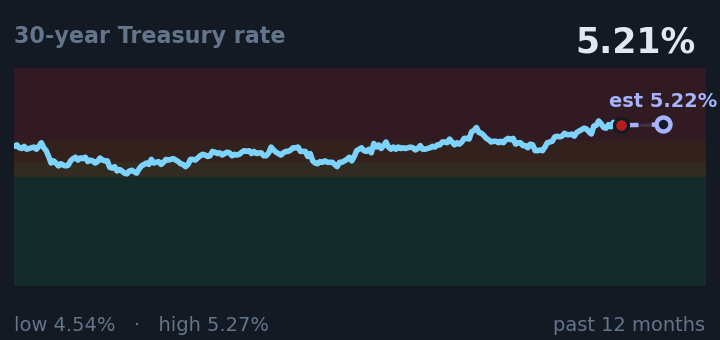
Thirty-year Treasury yields at 5.21% sit in the fiscal sustainability crisis zone, where higher government borrowing costs force deficit concerns that reshape economic policy.
Source: FRED
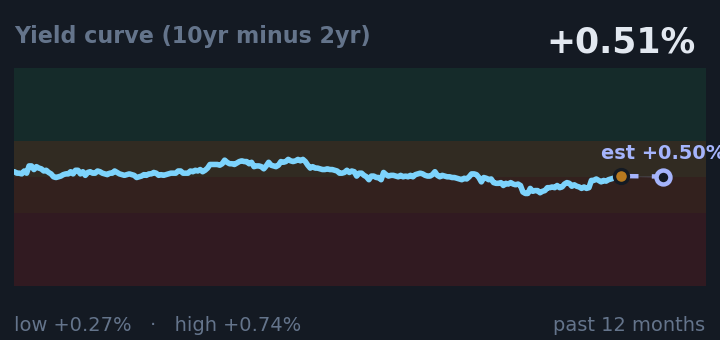
The yield curve spread at +0.51% sits in the normal range, indicating traders do not yet price an imminent recession despite other pressures.
Source: FRED
Jobless claims at 209,000 remain in the healthy range, providing one stabilizing force for household income security even as other wallet pressures persist.
Source: FRED
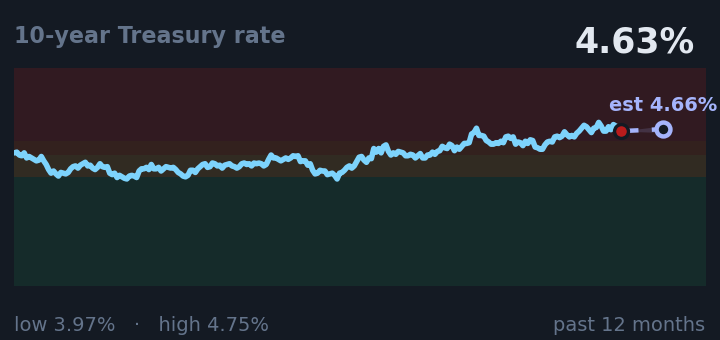
Ten-year Treasury yields at 4.63% sit in the bond vigilante pressure zone where traders historically force policy reversals if government fiscal commitments appear unsustainable.
Source: FREDIn plain terms: the public’s money is leaning that this will not happen, and held steady overnight.
The platforms disagree on the margin of victory for Democrats in the New Hampshire Senate election, with Polymarket pricing a close race (2%) and Kalshi indicating a wider margin (24% chance it's at least 8 points).
In plain terms: the public’s money is close to a coin flip on whether this will not happen, and held steady overnight.
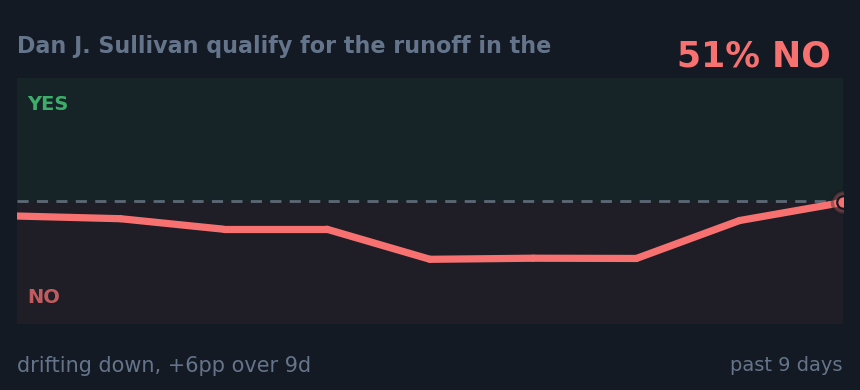
Polymarket and Manifold price Sullivan's win at 38% and 36%, respectively, while Kalshi's related question implies a lower probability, indicating a disagreement between platforms on Sullivan's chances.
In plain terms: the public’s money is leaning that this will not happen, and held steady overnight.
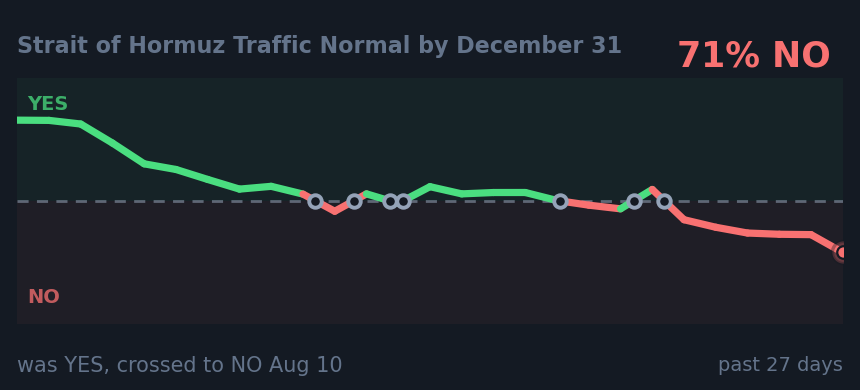
Polymarket and Manifold agree on an average probability of 83%, with a 2-point spread between their prices, indicating moderate consensus among traders that traffic will return to normal by the end of the year.
In plain terms: the public’s money is leaning that this will not happen, and held steady overnight.
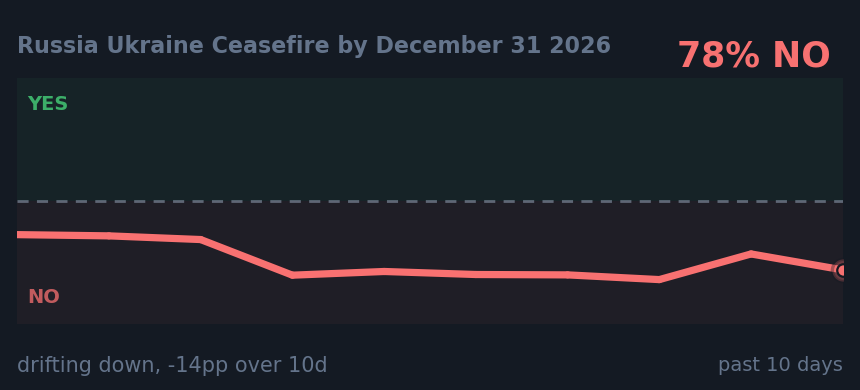
Market prices a 35% probability of a formal ceasefire agreement within 18 months despite ongoing humanitarian violations and no visible diplomatic momentum. Resolution depends on battlefield dynamics, third-party mediation, or war exhaustion—currently underweighted given geopolit
In plain terms: the public’s money is leaning that this will not happen, and held steady overnight.
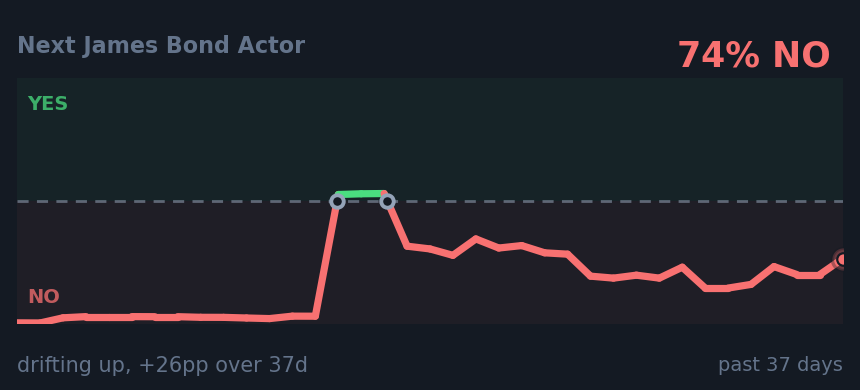
Polymarket and Kalshi disagree on Henry Cavill's chances, with Polymarket at 0% and Kalshi at 6%, indicating a 5-point spread that highlights a significant disagreement between the platforms on his likelihood of being cast.
Hamas attack of 7 Oct 2023 followed by ongoing IDF operations in Gaza; ripples into Hezbollah / Houthi / Iran lanes.
Russian invasion that began Feb 2022; front lines largely static along the Donbas / Zaporizhzhia axis. Drives Brent, gas, grain, defense-stock pricing.
SAF vs RSF civil war since April 2023. Khartoum + Darfur worst-hit. Off most newsfeeds — drives African food-aid and gold-flow markets.
Houthi missile/drone attacks on Red Sea shipping diverting traffic around the Cape. Bumps WTI, shipping rates, supply-chain timing markets.
Post-coup civil war between junta and PDF + ethnic armed organizations. Junta losing territory in Shan + Rakhine since late 2023.
| AMERICAS | 0 rose 0 fell 2 flat |
| EUROPE | 0 rose 0 fell 1 flat |
| ASIA | 0 rose 0 fell 0 flat |
| MENA | 0 rose 0 fell 1 flat |
| AFRICA | 0 rose 0 fell 0 flat |
| CRYPTO | 0 rose 0 fell 0 flat |