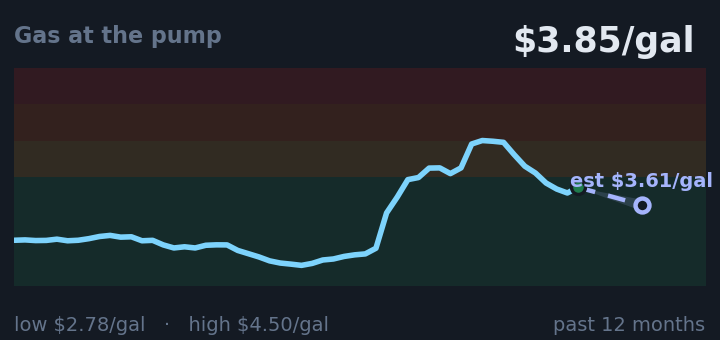
Gas prices affect what households pay to fill up and what shipped goods cost, rippling through grocery, heating, and transportation.
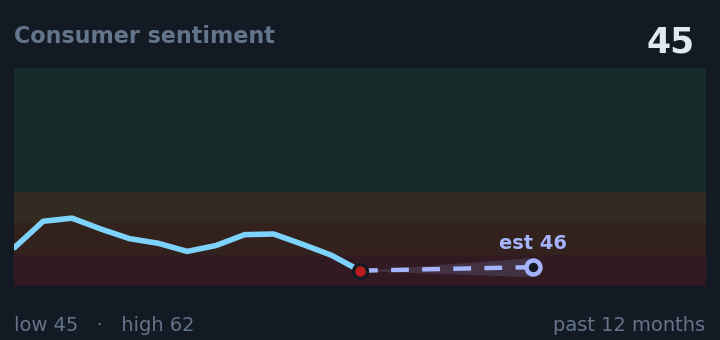
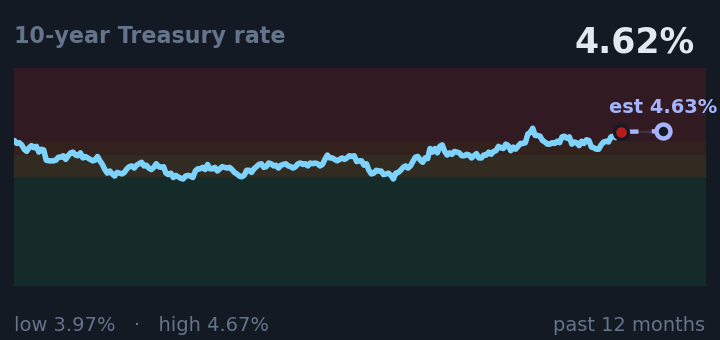
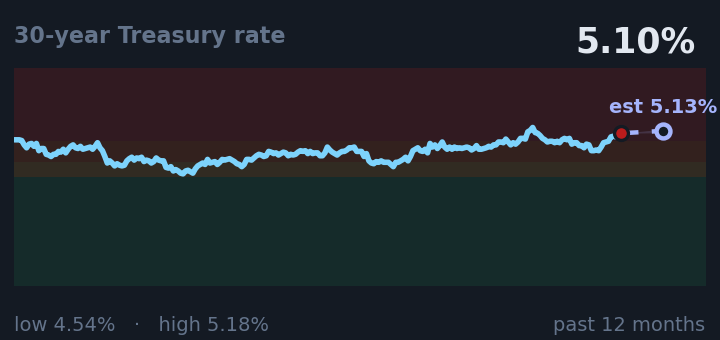
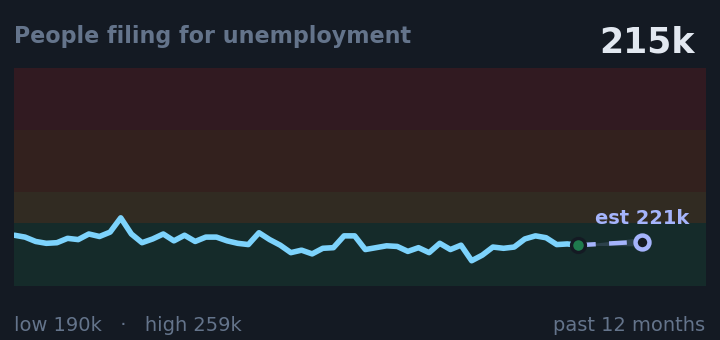
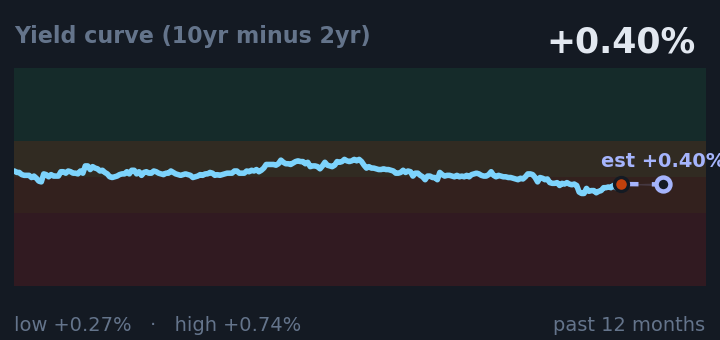
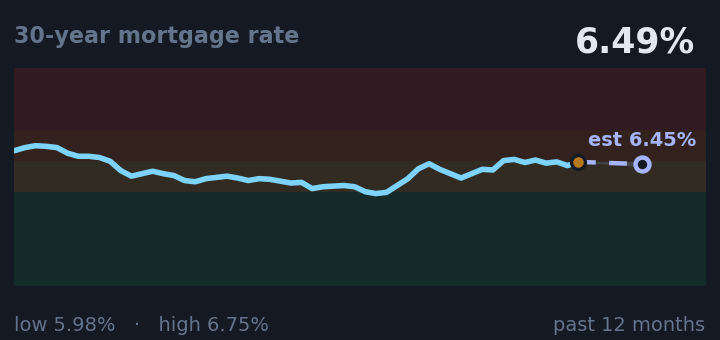
A market that this brief named just two days ago has moved sharply: on July 12, traders put the odds of J.D. Vance leaving the cabinet at 12 percent, and now they're at 38 percent, a 26-point move that signals a sharp reassessment of political risk in Washington. Five of the day's largest moves cluster across America, from questions about whether the Federal Reserve will raise rates to the odds of slower economic growth, the 2026 Senate race in Maine, state tax policy in California, and broader bets on where the U.S. economy is heading. Long-term interest rates have climbed to near the highest levels of the past year: the 10-year Treasury is now 4.62 percent and the 30-year is 5.10 percent, which translates directly into higher mortgage costs, higher car loan costs, and higher costs for any loan a family might take out. Gas prices remain under pressure, down to $3.85 a gallon from $4.15 a month ago, but consumer sentiment is still stuck at 45, the lowest in a year, suggesting that lower gas has not yet restored household confidence enough to spur spending. The job market showed the one bright spot: fewer people filed for unemployment, with claims falling to 215,000. The yield curve stays around 0.40%, a recession warning that has held for weeks.
→ Open the live interactive board
Get this every morning
Delivered to your inbox at 6:30, with the full archive, alerts, and the live board →
Gas prices affect what households pay to fill up and what shipped goods cost, rippling through grocery, heating, and transportation.
Consumer sentiment predicts whether households will spend or save, which determines whether the economy grows or weakens.
The 10-year Treasury rate influences mortgage rates, business loans, and government borrowing costs.
The 30-year Treasury rate directly sets mortgage rates, so higher rates make homes more expensive and reduce what buyers can afford.
Jobless claims show whether companies are hiring or laying off, which determines if household income is secure.
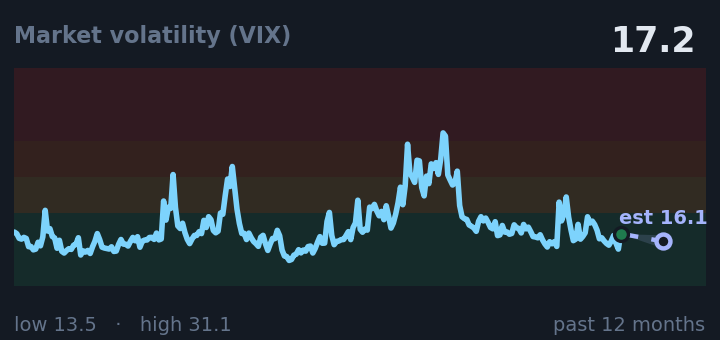
Market volatility measures investor fear and can predict sharp market moves.
Source: FRED
The yield curve shows the gap between long-term and short-term borrowing rates; when this gap reverses, history shows a recession usually follows.
Mortgage rates determine how much a home costs to buy and how much buyers can afford.
Source: FRED
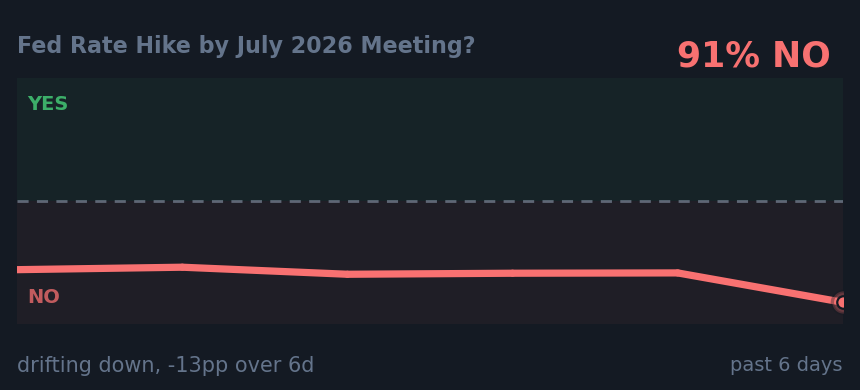
In plain terms: the public’s money is very confident this will not happen, and held steady overnight.
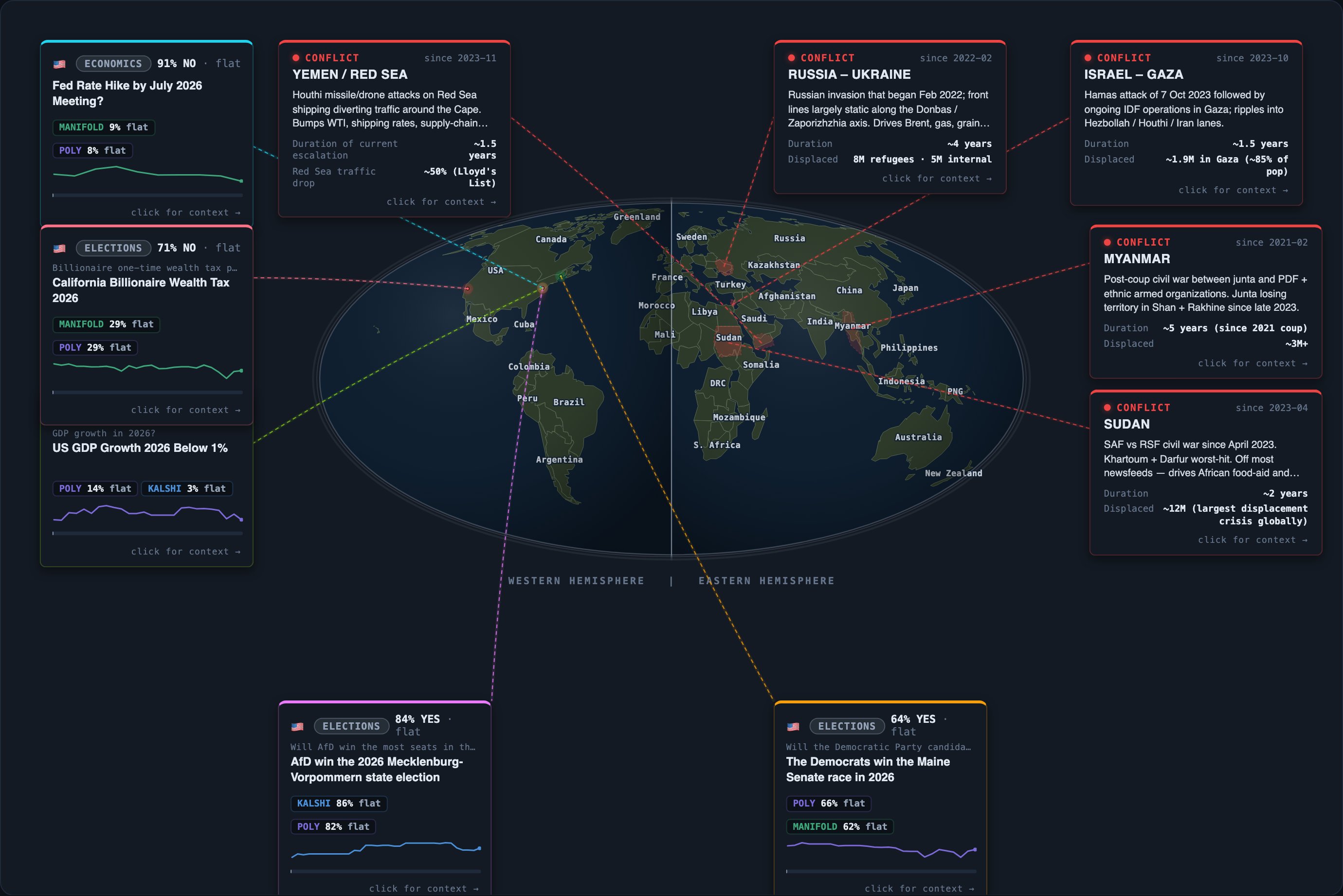
Manifold and polymarket agree on a 21-22% probability of a rate hike at the July 2026 FOMC meeting, indicating moderate market consensus with no clear bias towards higher or lower odds.
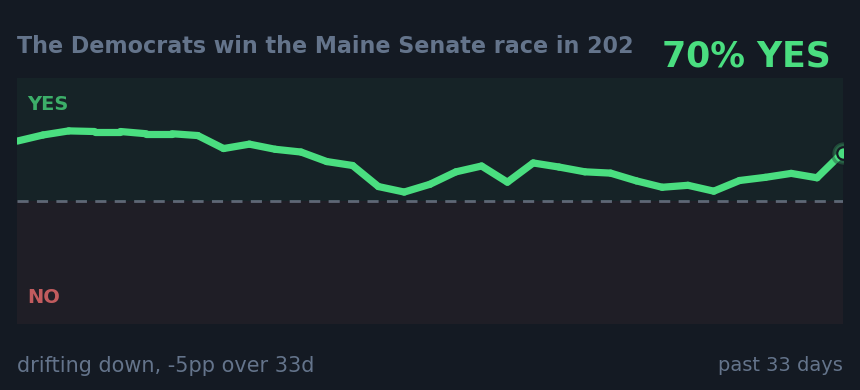
In plain terms: the public’s money is close to a coin flip on whether this will happen, and held steady overnight.
Strong Democratic lean (77% avg) reflects incumbent advantage in a blue state, though 4-point spread suggests meaningful uncertainty. Depressed consumer sentiment and elevated gas prices pose headwinds to party-in-power dynamics that could tighten the race closer to 2026.
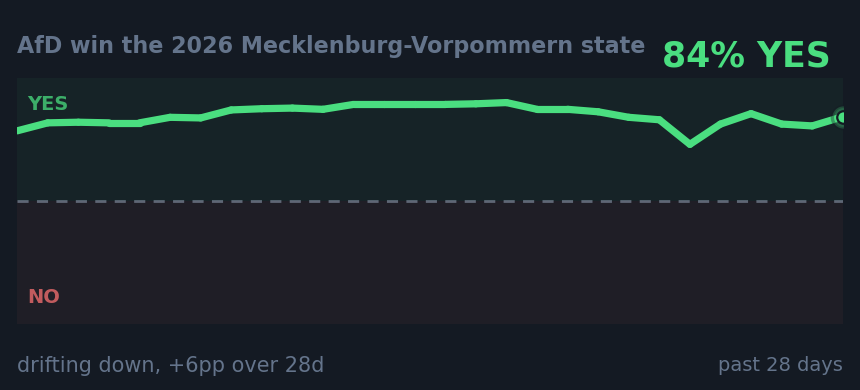
In plain terms: the public’s money is leaning that this will happen, and held steady overnight.
Kalshi and Polymarket agree that AfD has a 90-86% chance of winning the most seats, a 4-point spread indicating a moderate level of disagreement about the outcome.
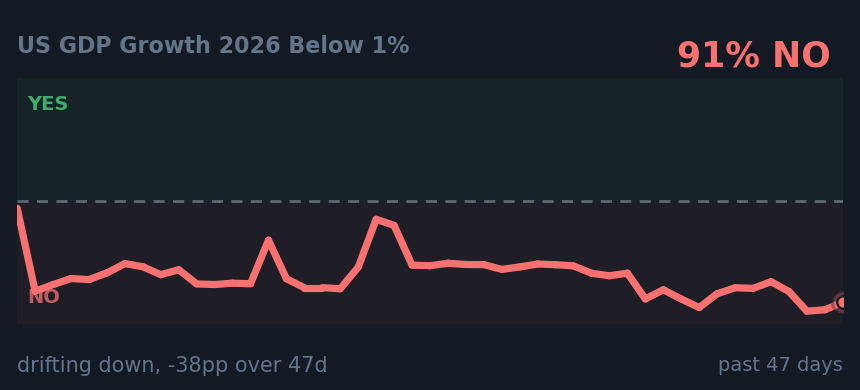
In plain terms: the public’s money is very confident this will not happen, and held steady overnight.
Kalshi prices severe contraction (4%) while Polymarket prices mild slowdown (12%), reflecting uncertainty about whether depressed consumer sentiment and rising bond yields trigger recession or soft landing. The 8-point spread suggests material disagreement on 2026 growth trajecto
In plain terms: the public’s money is leaning that this will not happen, and held steady overnight.
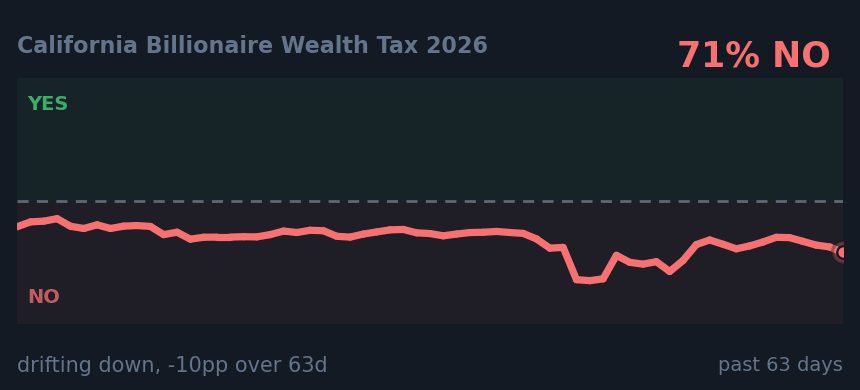
Markets consensus at 35% reflects skepticism toward a redistributive tax measure in a depressed consumer environment. The tight 2-point spread signals genuine uncertainty, with elevated gas prices historically suppressing ballot support for tax initiatives.
Hamas attack of 7 Oct 2023 followed by ongoing IDF operations in Gaza; ripples into Hezbollah / Houthi / Iran lanes.
Russian invasion that began Feb 2022; front lines largely static along the Donbas / Zaporizhzhia axis. Drives Brent, gas, grain, defense-stock pricing.
SAF vs RSF civil war since April 2023. Khartoum + Darfur worst-hit. Off most newsfeeds โ drives African food-aid and gold-flow markets.
Houthi missile/drone attacks on Red Sea shipping diverting traffic around the Cape. Bumps WTI, shipping rates, supply-chain timing markets.
Post-coup civil war between junta and PDF + ethnic armed organizations. Junta losing territory in Shan + Rakhine since late 2023.
| AMERICAS | 0 rose 0 fell 5 flat |
| EUROPE | 0 rose 0 fell 0 flat |
| ASIA | 0 rose 0 fell 0 flat |
| MENA | 0 rose 0 fell 0 flat |
| AFRICA | 0 rose 0 fell 0 flat |
| CRYPTO | 0 rose 0 fell 0 flat |