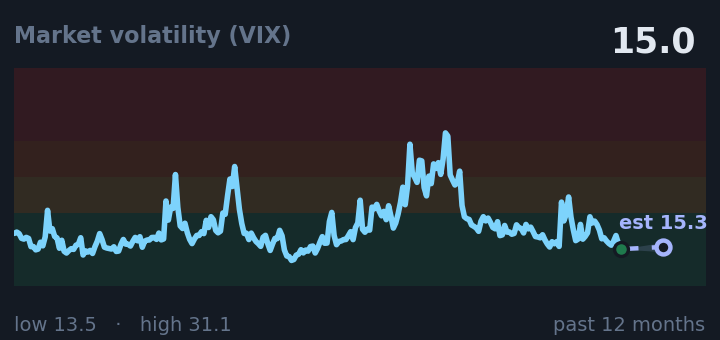
Market volatility reflects investor confidence; high readings mean fear is rising, low readings mean calm.
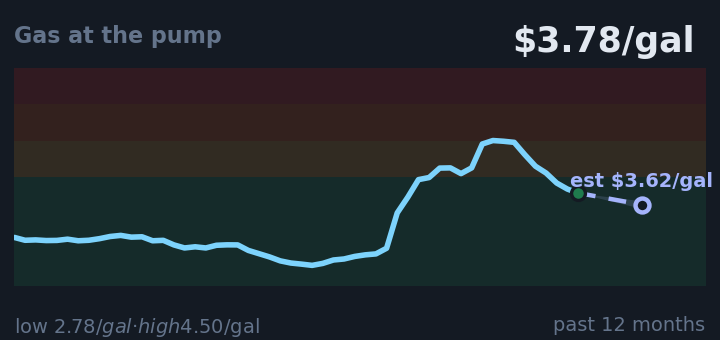
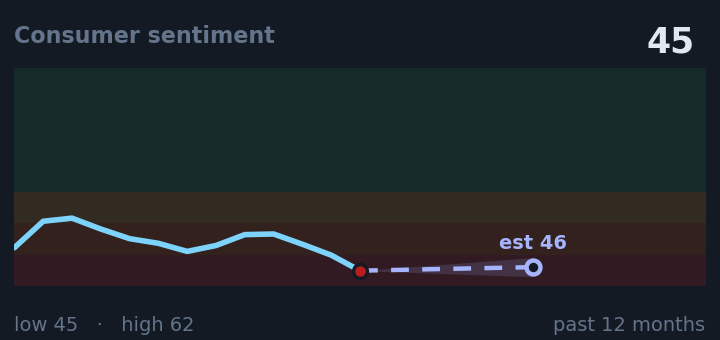
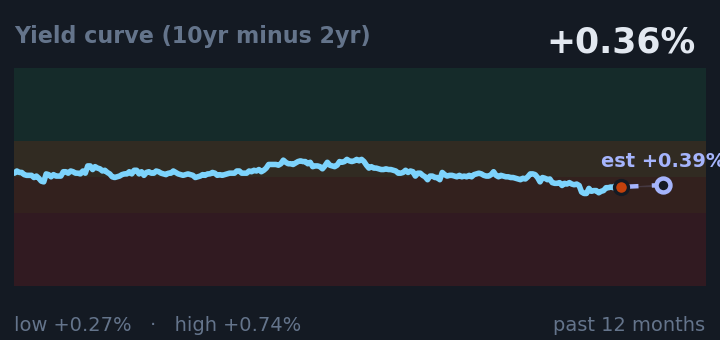
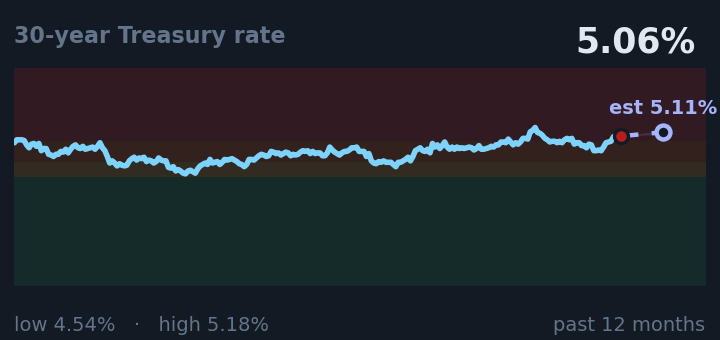
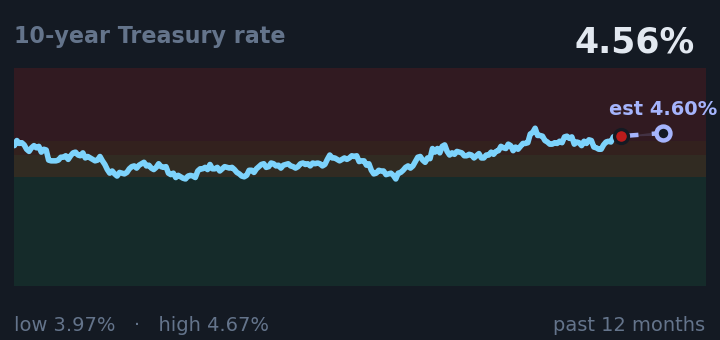
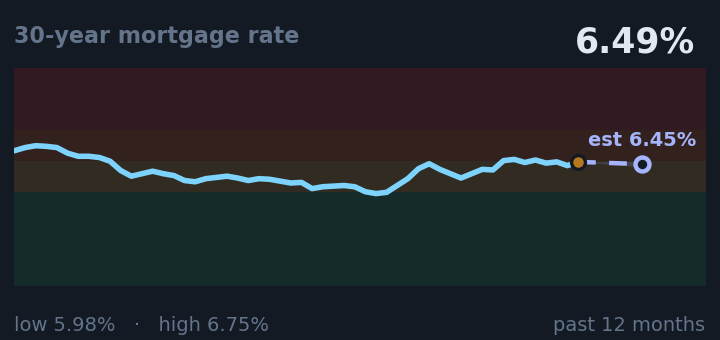
Traders changed their minds about Tesla: the market's odds that the automaker will boost deliveries this year climbed from below the 50% line to 66% YES, a 27-point swing that signals growing confidence in the company's manufacturing plans. Separately, the cabinet-churn market shifted toward Robert F. Kennedy Jr.'s departure, now reading 54% YES that he leaves before year-end, up 30 points from a week ago, signaling that markets see volatility in the administration's personnel. These moves sit outside the usual geo-political clusters, driven by corporate and political assessments rather than geography. Gas prices have drifted down to $3.78 a gallon over the past month, yet consumer sentiment remains stuck at 45, the lowest in a year, meaning that even lower pump prices haven't restored family confidence in spending. The long-term constraints persist: mortgage rates sit at 6.49%, Treasury yields at crisis-level 4.54% for the 10-year and 5.05% for the 30-year, and the yield curve remains flat at 0.35%, all holding steady from a month ago.
→ Open the live interactive board
Get this every morning
Delivered to your inbox at 6:30, with the full archive, alerts, and the live board →
Market volatility reflects investor confidence; high readings mean fear is rising, low readings mean calm.
What you pay for gas directly affects household budgets and consumer spending across the economy.
How confident families feel about their economic future determines whether they spend on big purchases or pull back.
When the gap between long-term and short-term rates shrinks, it historically warns of an economic slowdown ahead.
Source: FRED
Long-term borrowing rates determine mortgage rates and the cost of government debt, affecting both homebuying and fiscal policy.
The 10-year rate influences what companies pay to borrow money and signals market expectations for economic growth.
Mortgage rates set how expensive homes are; higher rates make monthly payments larger and fewer homes affordable.
Source: FREDIn plain terms: the public’s money is very confident this will not happen, and held steady overnight.
Market consensus at 10% reflects skepticism of a near-term announcement given Vance's current VP role and weak economic conditions (gas $4.12, consumer sentiment 57) that typically disfavor incumbent administration moves. Agreement across platforms suggests genuine uncertainty ra
In plain terms: the public’s money is very confident this will not happen, and held steady overnight.
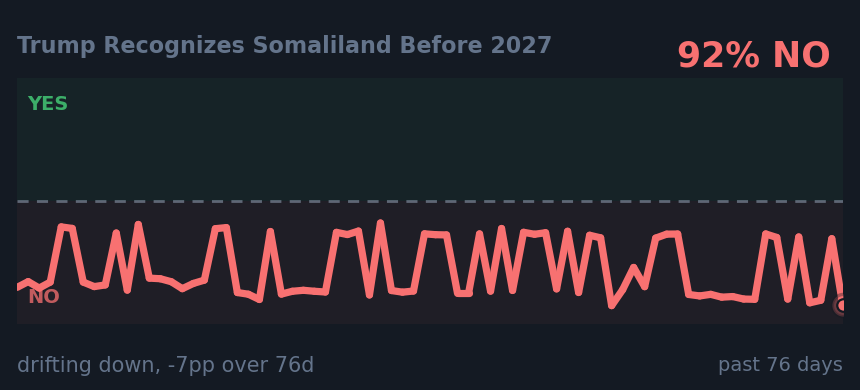
Massive 48-point spread between Kalshi (63%) and Polymarket (15%) on U.S. recognition of breakaway Somaliland. Disagreement likely reflects different interpretations of Trump's foreign policy priorities, geopolitical constraints with Somalia, and whether recognition occurs via ex
In plain terms: the public’s money is close to a coin flip on whether this will not happen, and grew less sure overnight.
Polymarket prices Gabbard's exit before 2027 at 100%, suggesting near-certainty she'll leave first among Cabinet members. The perfect agreement across platforms indicates strong consensus, though 100% pricing may reflect low liquidity rather than genuine inevitability.
In plain terms: the public’s money is close to a coin flip on whether this will not happen, and grew much less sure overnight.
Extreme 47-point spread (Kalshi 50% vs Polymarket 3%) suggests fundamental disagreement on Nazare's viability. Depressed consumer sentiment and elevated gas prices create headwinds for incumbent-aligned candidates, but the massive probability divergence indicates markets lack con
In plain terms: the public’s money is very confident this will not happen, and grew much more sure overnight.
Modest spread (6pts) reflects genuine uncertainty on a ~21-month timeframe with mixed macro signals. Strong risk appetite (tight credit spreads, normal VIX) supports bullish case, but 10Y yield near policy inflection point and DOJ uncertainty create headwinds. Fair value likely 4
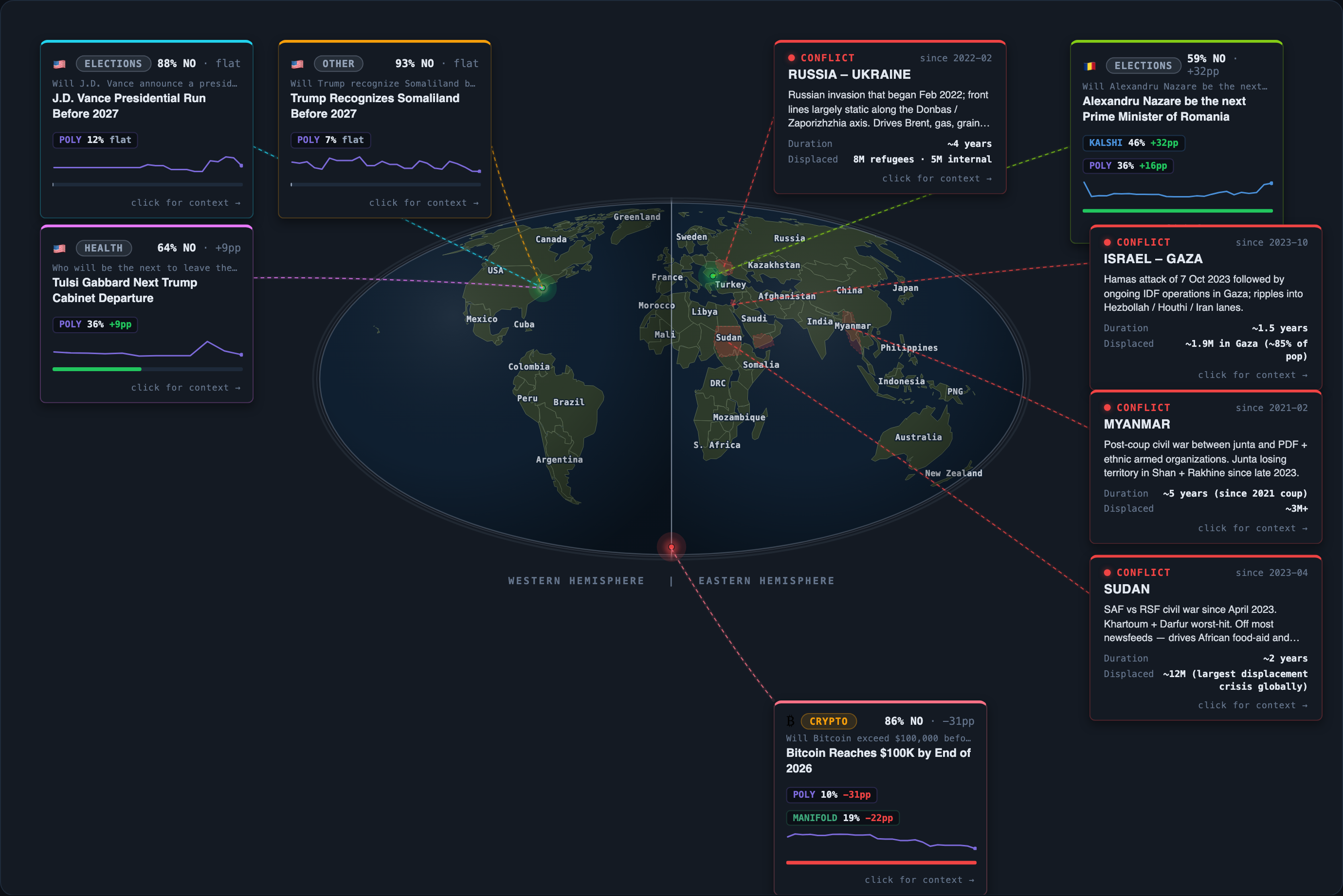
Hamas attack of 7 Oct 2023 followed by ongoing IDF operations in Gaza; ripples into Hezbollah / Houthi / Iran lanes.
Russian invasion that began Feb 2022; front lines largely static along the Donbas / Zaporizhzhia axis. Drives Brent, gas, grain, defense-stock pricing.
SAF vs RSF civil war since April 2023. Khartoum + Darfur worst-hit. Off most newsfeeds — drives African food-aid and gold-flow markets.
Houthi missile/drone attacks on Red Sea shipping diverting traffic around the Cape. Bumps WTI, shipping rates, supply-chain timing markets.
Post-coup civil war between junta and PDF + ethnic armed organizations. Junta losing territory in Shan + Rakhine since late 2023.
| AMERICAS | 1 rose 0 fell 2 flat |
| EUROPE | 1 rose 0 fell 0 flat |
| ASIA | 0 rose 0 fell 0 flat |
| MENA | 0 rose 0 fell 0 flat |
| AFRICA | 0 rose 0 fell 0 flat |
| CRYPTO | 0 rose 1 fell 0 flat |